
Most platforms in this series hide from scrutiny. NRC does something more interesting — it walks straight toward it. It displays a CAC registration number on its website, presents itself as “National Reading Culture Ltd,” a government-aligned literacy initiative, and positions its VIP task system as a way for everyday Nigerians to benefit from a media company’s growth. It looks, at first glance, like a platform that has something to prove.
But here’s the thing: being registered with the CAC and being what you say you are on your website are two completely different things. NRC’s own CAC filing — the one it proudly links to — tells a different story than its homepage does. That’s where this review starts.
⚠️ Disclaimer: This review is for educational purposes only. Never deposit money you cannot afford to lose into any online investment platform, regardless of whether it displays government registration credentials.
The CAC Trick Nobody Talks About
NRC (operating on nrc.cc and the related domain nnnrc.com) is registered with Nigeria’s Corporate Affairs Commission, and it makes sure you know about it. That registration is one of the first things many users cite when defending the platform.
Here’s what they don’t mention: NRC’s CAC filing categorizes its business activity as “Information services.”
Not financial services. Not investment management. Not a task-based earning platform. Information services.
This is a meaningful distinction, and one independent reviewer put it precisely: imagine a bank registering on CAC as a school. The registration wouldn’t be false, exactly — the company exists, the paperwork is filed, the number is real — but the activity category would be deliberately evasive about what the company actually does to make money.
A platform that requires you to deposit between ₦18,900 and ₦16,100,000 in exchange for daily returns is providing a financial service. Registering it as “information services” isn’t a paperwork oversight. It’s the kind of category choice you make when you want legal cover without attracting the attention of the SEC or CBN. That single fact reframes everything else NRC presents as a credibility signal.
Also Read: Is Anywheel-io.com Legit? An Evidence-Based Review (2026)
What NRC Actually Is
The branding is “National Reading Culture” — a name that evokes literacy drives, government partnerships, and the kind of socially responsible business that sounds good at a press conference. The logo features a book. The homepage talks about “helping people grow their businesses” and “building a resource network covering more than 2,000 partners in more than 30 countries.”
Strip all of that away and what you have is a straightforward fixed-return VIP deposit scheme:
- You pay to upgrade to a VIP level
- The platform assigns you daily “reading tasks” (literally clicking a button labeled “read”)
- You earn a fixed naira amount each day based on your VIP tier
- You recruit others to do the same
- A 10% commission flows to you from your referrals’ upgrade deposits
There’s no reading content. No media partnership network. No brand awareness service being delivered to actual clients. The “tasks” are a cosmetic layer — a way to make the deposit-and-earn structure look like a business operation rather than what it mechanically is. One independent reviewer who went through the dashboard described the tasks as: “just clicking ‘read.’ No real activity — just button tapping.”
The VIP Plans When the Math Tells You Everything
<cite index=”12-1″>NRC uses a VIP system, where your earnings depend on how much you deposit.</cite> Here’s the full picture, verified from dashboard screenshots:
| VIP Level | Deposit (₦) | Daily Earning (₦) | Days to Break Even |
|---|---|---|---|
| VIP1 | 18,900 | 630 | ~30 days |
| VIP2 | 54,000 | 1,800 | ~30 days |
| VIP3 | 174,000 | 6,000 | ~29 days |
| VIP4 | 420,000+ | ~14,000 | ~30 days |
| VIP5 | 1,000,000+ | ~35,000 | ~29 days |
| VIP6 | 2,500,000+ | ~90,000 | ~28 days |
| VIP7 | 5,000,000+ | ~180,000 | ~28 days |
| VIP8 | 10,000,000+ | ~350,000 | ~29 days |
| VIP9 | 16,100,000 | 700,000 | ~23 days |
Notice the pattern: every single tier is structured to return your deposit in roughly 30 days, then continue paying indefinitely. That uniformity — consistent 30-day break-even across nine wildly different deposit amounts — is not how any real business operates. Revenue from actual clients doesn’t scale like that. What does scale like that is a formula someone wrote to make the math look tidy and attractive.
Also worth pausing on: <cite index=”13-1″>to upgrade to VIP 1, you need 18,000 naira but you only get to earn 600 naira on a daily basis.</cite> That’s a poor earning structure even by the standards of similar platforms, which means the platform is buying time — structuring payouts low enough that new deposits can keep pace with withdrawals for longer than platforms with more aggressive return promises. It’s a slower burn, not a safer one.
How Registration Actually Works — And What It Doesn’t Tell You
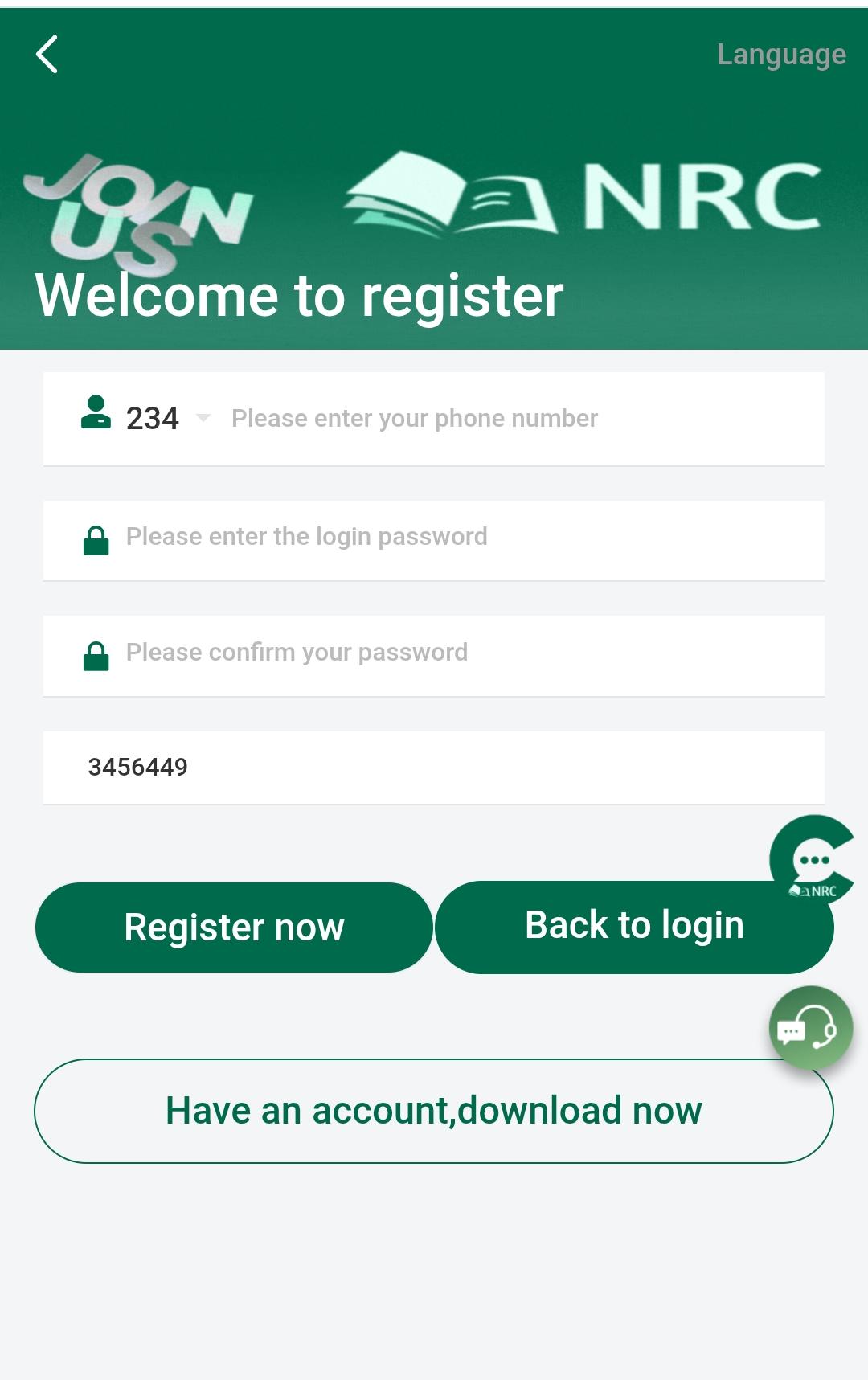
Sign-up requires a phone number, password, and a referral code. That last part is mandatory, not optional — you can only register through someone else’s link, which by design makes the platform’s entire growth engine dependent on recruitment.
From the WHOIS data documented by independent reviewers: the domain nnnrc.com was registered on February 10, 2025, via Gname.com — a registrar that appears frequently in reviews of short-lived earning platforms. That gives it roughly 16 months of operating history at the time of this review. The separate nrc.cc domain appears to have a similar or later vintage.
No email verification. No identity verification. <cite index=”12-1″>Accounts can disappear or reset</cite> — a complaint seen in independent user reports.
The Referral Architecture
NRC’s referral system has two layers:
Direct commissions: You earn 10% of whatever your referral spends on a VIP upgrade. If they deposit ₦174,000 for VIP3, you get ₦17,400. If they go straight to VIP9 at ₦16.1 million, you’d theoretically receive ₦1.61 million.
Growth Rewards (milestone bonuses): Separate from the commission, NRC runs a milestone system — <cite index=”3-1″>you can earn between ₦650 and ₦32,800 on the growth reward</cite>, tied to how many people you’ve successfully recruited. These reset after each claim, incentivizing you to keep recruiting beyond your initial network.
What this creates is a structure where the most rational thing to do on NRC is not to carefully click “read” tasks — it’s to recruit aggressively, push your referrals toward higher VIP tiers, and collect the 10% commission on whatever they deposit. <cite index=”12-1″>Notifications like “User recruited VIP3 and earned ₦17,400″</cite> are pushed to the dashboard to make this very visible to everyone on the platform. That’s not accidental; it’s a behavioral nudge toward recruitment over task completion.
The App Problem
The NRC app is not available on the Google Play Store or Apple App Store. It’s distributed as a direct APK download, accessible only after you register and log in through the browser. Installing it requires manually enabling “Install from Unknown Sources” in Android settings — bypassing the security review that both major app platforms require.
<cite index=”12-1″>Installing unknown APK can steal your data, access your SMS or bank info, and install hidden malware.</cite> That’s not a remote theoretical risk; it’s the documented mechanism of a significant category of financial fraud in Nigeria. The decision to distribute via APK rather than app stores is a meaningful operational choice that deserves more weight than it typically gets in discussions of platforms like this.
Is NRC Legit? Key Factors Analyzed
Company Transparency — A CAC number is displayed, but the registration category (Information services) doesn’t match the actual product (a deposit-based earning and investment scheme). No founder, CEO, or executive team is named anywhere. <cite index=”13-1″>No registered business anywhere in the world can operate without a social media presence</cite> — and NRC has none: no verified Facebook page, no official Instagram, no Twitter/X account. Its entire social media existence is users promoting referral links from their personal accounts, not the company communicating directly.
Domain History — Registered February 10, 2025, through a low-cost registrar frequently associated with short-lived platforms. Under 18 months of operation.
Business Model — <cite index=”4-1″>Tasks are just clicking ‘read.’ No real work = no real income source.</cite> If the “reading tasks” don’t generate actual value for any external client, the only place payout money can realistically come from is new user deposits. That’s the textbook definition of a Ponzi structure, regardless of how the company registered itself or what its homepage says.
Withdrawal Mechanics — Processed only between 10:00 AM and 6:00 PM, with a taxation fee applied on top (e.g., ₦180 deducted from a ₦1,800 withdrawal). Bank card and fund password setup are required before the first withdrawal can process. <cite index=”12-1″>Many scam platforms allow small withdrawals at first, then block larger ones.</cite>
Sustainability — <cite index=”13-1″>Ponzi or pyramid schemes like NRC crash when there is much financial pressure — when the payout outweighs the number of deposits. In the case of NRC, their payout structure is very low, so the number of Peters depositing are enough to pay the Pauls that may be withdrawing, thus creating a false idea that it’s a long-lasting platform.</cite> Low payout rates extend the lifespan. They don’t change the outcome.
Risk Factors at a Glance
- CAC registration category deliberately mismatches actual business activity
- Domain registered February 2025 — under 18 months old
- Fixed daily returns with a suspiciously consistent ~30-day break-even across all tiers
- “Tasks” are button taps with no real output or client value
- No official social media presence for a company claiming 2,000+ global partners
- App distributed via APK only, bypassing app store security review
- External chat support (chat2y.cfd) rather than an official platform contact
- User complaints include accounts disappearing after funding
Red Flags Worth Naming Clearly
The CAC Category Mismatch — This isn’t bureaucratic sloppiness. Registering a financial-services business as “Information services” is a deliberate evasion of the regulatory scrutiny that financial service providers face. It’s the most specific, verifiable piece of evidence that the operators know exactly what they’re doing and chose to obscure it.
No Social Media Footprint — A company claiming to have “2,000+ partners in 30 countries” and a global media operation has no verified official presence on any social platform. What it has instead is thousands of individual users sharing referral links. That’s not a media company. That’s a recruitment network.
Fake-Looking Activity Notifications — Dashboard notifications like “User recruited VIP3 and earned ₦17,400” are designed to create a sense of a busy, paying platform. These are automated messages — there’s no way to verify they reflect real transactions rather than generated hype.
The APK Distribution Choice — Legitimate financial apps go through app store review. The choice to skip that process is not neutral.
Positive Aspects
Balance matters even here:
- The platform does at least display a CAC registration number, which is more disclosure than many competitors provide — even if the category chosen is deliberately evasive.
- VIP1 at ₦18,900 is a lower entry point than some platforms in this space.
- Some early users have reported small, functional withdrawals — the low payout structure does appear to allow some payments to flow, at least in the short term.
- A Trial VIP level exists, giving a limited taste of the platform without an immediate deposit requirement.
What Real Users Are Saying
<cite index=”12-1″>Positive comments, likely from promoters, include “tested and trusted,” “I earned today,” and “join now.” These are usually early users or affiliates trying to recruit.</cite>
The more telling comments come from users who’ve already signed up:
- “Can’t do my task, I don’t know why”
- “My account disappeared after funding”
- “Is withdrawal everyday?”
Replies to complaints consistently push users to “DM your manager” — an external, unverifiable communication channel that removes any accountability from the platform itself and places the relationship in private messages where no one else can see what happens next.
NRC: Scam or Legit?
<cite index=”4-1″>NRC (nnnrc.com) is not a legitimate earning platform. It has all the signs of a Ponzi scheme: fake tasks, deposit-based earning, heavy referral system, no real business model, and user complaints of lost accounts.</cite>
The CAC registration number doesn’t change that analysis — it complicates it, because it suggests a level of deliberateness that goes beyond the typical fly-by-night operation. Someone took the time to file the paperwork, chose a category that would minimize regulatory scrutiny, and built a product that could point to that filing as a trust signal. That’s more effort than most schemes bother with, which may be why NRC has lasted longer than comparable platforms.
But longevity isn’t legitimacy. <cite index=”13-1″>The reason it has a false sense of longevity is due to their poor earning structure — the pyramid has less pressure, but that doesn’t mean it will not still crash later on.</cite>
Verdict: a structurally dishonest platform with a longer runway than most in its category, but the same inevitable endpoint.
Pros and Cons
| Pros | Cons |
|---|---|
| CAC registration number displayed | Registered as “Information services,” not financial services — a deliberate mismatch |
| Lower entry point than some comparable platforms | Fixed returns across all tiers follow a formula, not real business economics |
| Trial VIP level exists before deposit | Tasks are button taps with no real output or client value |
| Some early users report functional small withdrawals | No official social media presence for a “global media company” |
| — | App only available as unofficial APK — bypasses app store security review |
| — | Accounts have disappeared after funding, per user complaints |
Who Should Join?
If you’re curious and want to explore the Trial VIP level without depositing, you risk only your phone number, your personal data, and the APK you’d need to install. That’s not zero risk — but it’s lower than depositing.
Beyond that? The evidence doesn’t support joining with any expectation of sustainable earnings.
Who Should Avoid It?
Anyone planning to deposit at any VIP level expecting reliable returns; anyone whose ₦18,900–₦16.1M would genuinely hurt to lose; anyone who would install an APK from an unknown source without understanding the data access that may come with it; and anyone swayed by the CAC registration number without reading what category NRC actually registered under.
Safer Alternatives
- Regulated investment options — Nigerian Treasury Bills, registered money market funds, or SEC-licensed investment platforms. Real returns, legal accountability.
- Freelancing (Fiverr, Upwork) — Income tied to actual delivered work, no deposit required.
- Legitimate affiliate marketing (Jumia Affiliate, Amazon Associates) — Commission from real, trackable product sales. The referral income is real because the underlying product sale is real.
- Content creation and blogging — Slower to build, but income tied to genuine audience rather than new deposits.
- Remote work platforms (Remote.co, LinkedIn) — Actual employment or contract relationships with accountability on both sides.
Conclusion
NRC is one of the more carefully constructed platforms in this space. The CAC registration, the “National Reading Culture” branding, the book logo, the language about global media partnerships — these aren’t cosmetic accidents. They’re a deliberate attempt to make a deposit-based, referral-driven investment scheme look like something else entirely.
The core facts don’t change because the packaging is polished:
- Registered under a deliberately evasive business category
- No real task value — clicking “read” doesn’t generate income from any external source
- A Ponzi-style structure kept alive by low payout rates and steady new recruitment
- No official social media presence for a company claiming global operations
- App distributed outside of any security-reviewed platform
- User accounts have disappeared after funding
Risk-management recommendation: Treat the CAC number as what it actually is — a registration for an “information services” business, not validation of a financial platform. If you’ve already deposited, document your transaction records and bank confirmation carefully. Don’t deposit further funds chasing returns on a structure that can’t sustain them indefinitely.
✅ Fact-Check Summary
| Claim | Verdict |
|---|---|
| NRC is a legitimate global media company with 2,000+ partners | False — no verifiable media operation, partner network, or global footprint was found; the “tasks” generate no external value |
| CAC registration proves legitimacy | Misleading — NRC is registered as “Information services,” not as a financial services provider; the filing obscures rather than validates the actual business activity |
| Daily earnings come from reading-task revenue | False — tasks are button taps; no external client or advertiser pays for them; payout source is new user deposits |
| The platform has no social media presence | True — independently confirmed; no official page found on any platform |
| Some users are being paid | Partially True — small early withdrawals appear functional; sustainability is the separate and more important question |
| The platform will keep paying long-term | False — the structure is Ponzi-dependent; low payout rates extend the runway but don’t change the eventual outcome |
Frequently Asked Questions
Is NRC (nrc.cc / nnnrc.com) legit? No. It’s a deposit-based earning scheme with fake tasks, a mismatched CAC registration, no official social media presence, and a Ponzi-style revenue structure.
What does NRC stand for? National Reading Culture Ltd — a name designed to suggest a government-aligned literacy initiative. In practice, it’s a VIP investment platform with daily returns funded by new user deposits.
Is NRC’s CAC registration proof that it’s safe? No. The registration exists but was filed under “Information services” rather than financial services — a deliberate choice that avoids SEC/CBN scrutiny while still being able to display a registration number as a trust signal.
Does NRC actually pay? Some early, small withdrawals appear to have processed. The platform’s deliberately low payout rates mean it can sustain payments longer than comparable schemes — but low payout rates also mean it takes much longer to recoup your deposit, increasing the window of exposure if (when) the platform stops paying.
Is the NRC app safe to install? The app is distributed as an APK file outside the Google Play Store and Apple App Store, bypassing security review. Installing it requires enabling “unknown sources” on your device — a meaningful security risk that’s separate from the financial risk of the platform itself.
How long would it take to break even on NRC VIP1? Approximately 30 days of uninterrupted daily earnings — assuming the platform keeps paying, which is the question the break-even math cannot answer.
Is NRC registered in Nigeria? It holds a CAC registration, but under “Information services” rather than the financial services category that its actual product falls under. One independent reviewer compared this to a bank registering as a school.
If you’ve experienced a withdrawal — successful or blocked — from NRC in 2025 or 2026, sharing that in the comments adds to a public record that currently consists mostly of promotional content from referrers rather than objective user experience reports.
Last updated: June 2026. Platform terms, VIP pricing, and withdrawal conditions may change — particularly as platforms like this sometimes adjust their structure in response to increased scrutiny.